Image reading trial using new software
We understand the importance of delivering the best possible breast screening service for Victorians.
We are always looking for ways to improve our service and ensure that people feel safe and supported when they come to us.
To support our culture of continuous improvement, we are testing a new way of reading breast screen images (mammograms).
Learn about what's changing and how this affects your screening
We will be rolling this trial out in our program and if you are invited to take part, you will receive an information sheet with your booking confirmation.
How will the trial work?
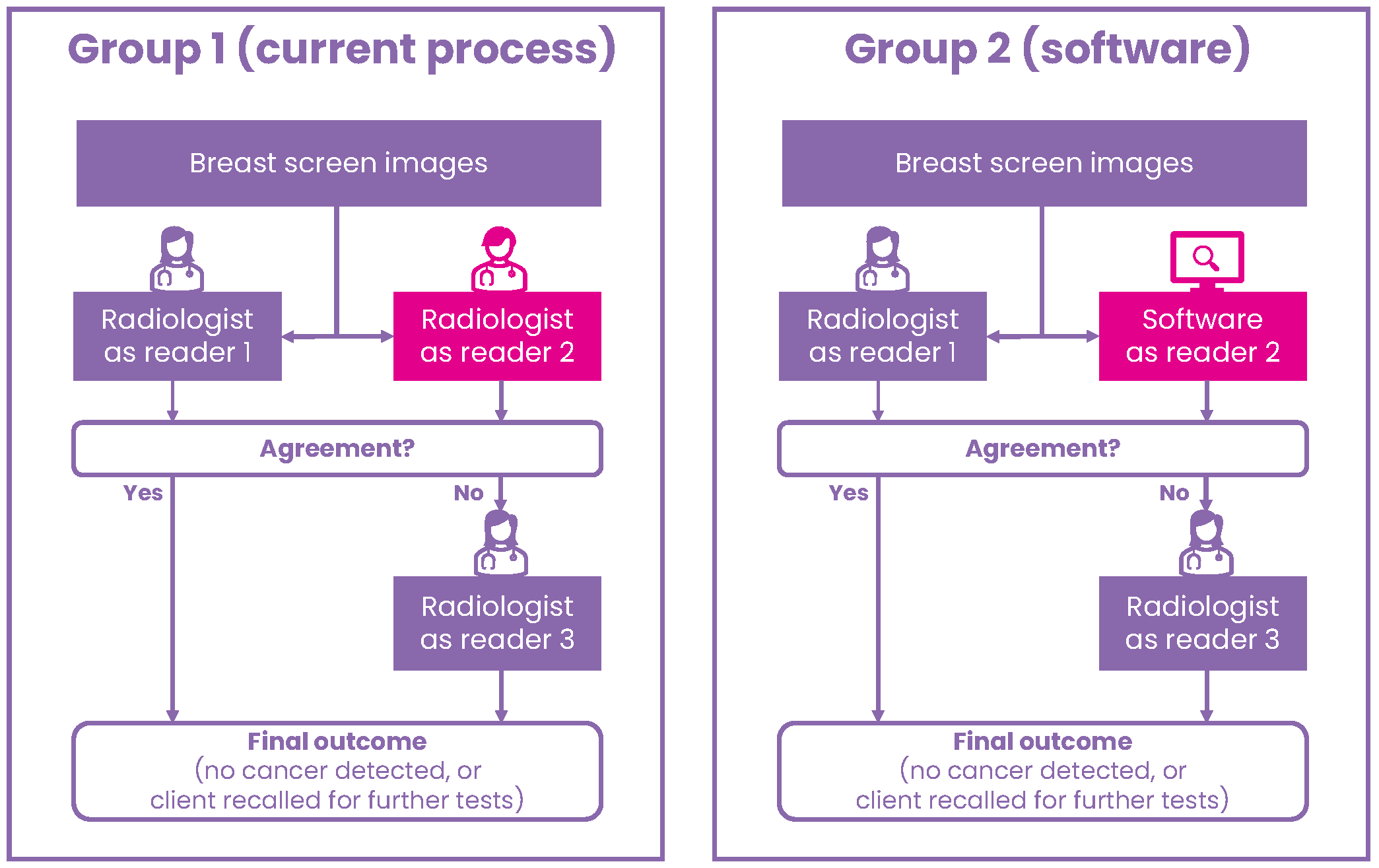
In the trial, new software will be used to read breast screen images. At least one specialist doctor (radiologist) will also read all images and make the final decision.
Participants will be split into 2 groups:
- Group 1 (current process): People in this group will have their images read by at least two specialist doctors (radiologists).
- Group 2 (trial): People in this group will have their images read using the new software and by at least one specialist doctor.
In both groups, if the doctors or software disagree about the results, another doctor will also read the images and make the final decision.
Our researchers will compare the results from these two groups. We want to be confident that reading images using software technology is just as accurate, or even better, than what we already do.
Click on image to view larger
What does it mean to participate in the trial?
Participating in the trial is optional. If you are invited to take part in the trial, you will receive an information sheet with your booking confirmation. This will provide you with information about the trial, including how you can opt out if you don’t want to participate.
You can opt out at any time until your appointment, and don’t need to give a reason. Opting out will not affect the care you receive during your appointment, or any follow up appointments. You can still have a breast screen, and it will be read using the current process.
What will change for the trial?
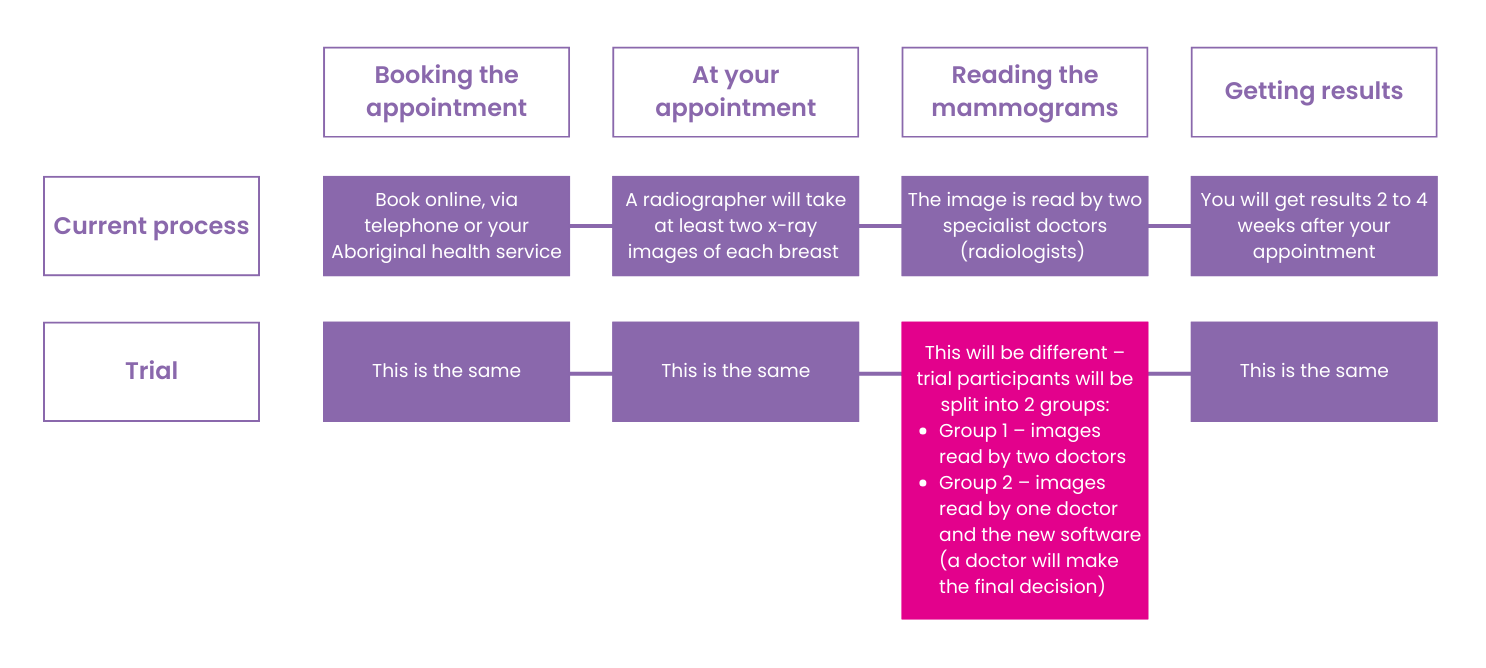
Your appointment experience won’t change. The way the images are taken and the staff caring for you during your appointment will also stay the same.
All images will still be read by a specially trained doctor (radiologist) who will make the final decision.
After your appointment, the way breast screen images are read may change if you are part of the trial. Images taken as part of the trial may also be read using new software.
Click on image to view larger
Why is this trial important?
This type of software, which was developed using artificial intelligence, is already being used in other parts of Australia. The evidence so far suggests it could help detect cancer early. This can increase treatment options and the likelihood of good outcomes. Before we start using this in Victoria, we are doing this trial to see if it can help us improve our service.
Frequently asked questions
The technology being used in this trial is software called an AI-reader. It has been developed by an Australian team using AI (artificial intelligence).
The reader was trained and developed using over 3.5 million images. After development, the reader was retrospectively tested on over 600,000 images. When operating as the second reader alongside a human reader, the AI-reader was shown to have higher sensitivity (correctly detecting the presence of cancer) and higher specificity (a reduction in the number of unnecessary recalls for further tests) than the current standard care of care, which is two human readers.
This trial is being conducted to test the reader’s performance prospectively, i.e., in real time. The software’s performance will be constantly monitored throughout the trial, and a human reader will always make the final decision.
If you participate in the trial, you will be randomly assigned to either Group 1 or Group 2. You can’t choose which group you’re in.
By participating, you will potentially help us find a way to detect more cancers, which could help save lives.
There are no new or extra risks related to participating in the trial. You may be asked to come back for further tests due to something potentially being detected in your images, which can also happen with the current assessment process. Most people who are asked back for further tests do not have breast cancer, but it is important to do these checks to make sure.
After your breast screen appointment, you can’t change how your images are read. This is because they may have already been read.
If you change your mind about participating, even if you didn’t opt out, your data (results from your breast screen images) can still be withdrawn from the research project while the project is in progress. This means the researchers delete the data and do not use this in analysis and reporting. You can do this by calling 13 20 50 or emailing readingtrial@breastscreen.org.au
Your breast screen records will remain in the BreastScreen Victoria database.
The research is a partnership between BreastScreen Victoria, BreastScreen South Australia, St Vincent’s Institute of Medical Research, St Vincent’s Hospital Melbourne, the University of Melbourne, Monash University and the University of Adelaide.
The study is led by Dr Helen Frazer who has over 20 years’ experience specialising in breast cancer screening. She is the State Clinical Director for BreastScreen Victoria, Clinical Director St Vincent’s BreastScreen and the Trial Program Leader.
The research is funded by the Federal Government.
Results from the research will be published in medical and scientific journals. No clients who participate in the trial will be identified. Results will also be available at breastscreen.org.au once the trial has been completed.
No. All participant data is de-identified when it enters the trial. Your name will not be published in connection with the trial. It is your choice whether you discuss your participation in the trial with anyone.
If you are invited to take part in the trial, you will receive an information sheet with your booking confirmation.
This will provide you with information about the trial, including how you can opt out if you don’t want to participate.
- People who don’t feel comfortable taking part can choose to opt out right up until their appointment. This means contacting BreastScreen Victoria to say you don’t want to take part. If you don’t do this, you will be considered a trial participant.
- You don’t need to give a reason for opting out. This will not affect the care you receive during your appointment, or any follow up appointments. You can still have a breast screen and it will be read using the current process.
- If you have questions, we encourage you to get in touch with us before your appointment. You are also welcome to speak with staff on the day of your appointment.
No, unfortunately not. Different sites may be running the trial at different times. The same quality of care will be provided to you whether you participate in the trial or not.
This research is overseen by the Royal Melbourne Hospital Human Research Ethics Committee. If you have any concerns about this research or the way it is being conducted, you can contact them and say the formal study name and project number:
Royal Melbourne Hospital Human Research Ethics Committee
HREC Executive Officer: Manager HREC
Phone: (03) 9342 8530
Email: research@mh.org.au
Study Name: A Multi-State, Single-Blinded Randomised Controlled Trial to Assess if the Implementation of a Deep Learning Classification Model Improves Mammogram Reading in Breast Cancer Population Screening (BRAIx RCT)
Project Number: 2024.045